
 NCCO International
 The receipt has had one simple foodservice job for over a century: tell the customer what they ordered and what they paid.
As the industry continues to grow and shift however, businesses are asking more from every part of their operation. Restaurant and retail operations are looking for ways to reduce waste, improve efficiency, simplify processes and make better use of the materials on which they have long relied.
The answer? The sticky back thermal receipt.
Rather than printing a receipt that is immediately separated from the order, linerless adhesive rolls allow businesses to turn that same receipt into a label that can be applied directly to packaging, bags, cups and containers.
In other words, the receipt has evolved it to become something new.

Small Change in Receipt Printing, Major Impact in the Bottom Line
It is easy to overlook something as ordinary as a receipt roll. It is a consumable, after all. It is purchased, loaded into a printer and used thousands of times without much thought.
This is exactly why reconsidering it can be valuable.
The materials businesses use every day are opportunities to improve how work gets done. A receipt roll that also functions as a label can reduce the number of materials involved in an order, remove the need for a separate backing liner and help employees keep order information connected to the product.
Those benefits extend beyond the printer. They can influence workflow, waste, packaging and the customer experience. As businesses continue to look for practical ways to do more with less, those incremental improvements matter.
Let’s look at the details.
A Single Print With Two Purposes
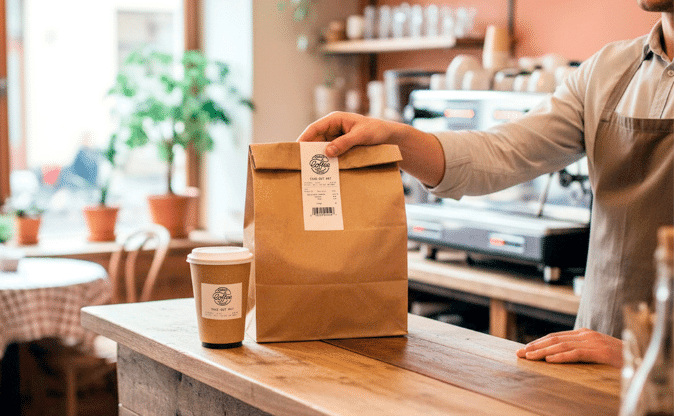
TTraditional receipt paper creates a familiar workflow. An order is printed, the receipt is handed to the customer or attached to an order, and a separate label may need to be printed for the food or container.
Sticky back thermal rolls simplify this process with a pressure-sensitive adhesive backing that can be applied directly to the item to which it belongs. Order information then travels with the product to help employees and customers identify what is inside without requiring a separate label.
Traditional receipts still have their place. But for fast-paced, quick service and to-go culture, stick thermal receipts give employees the added support they need. Instead of printing two pieces of material for two purposes, businesses can use one. This makes a meaningful difference in busy foodservice and retail environments where time is of the essence: Coffee or tea orders where the receipt will stick directly to the cup, to-go containers made of cardboard or bags made of paper lined up and waiting for customers during a rush.
Fast-Paced Foodservice
Let’s unpack this further. Foodservice operations do not have the luxury of slowing down during a busy service. Employees are busy handling orders, assembling meals, checking tickets, managing packaging and getting products out the door simultaneously. Anything that adds unnecessary steps can create friction.
Sticky back thermal rolls help bring printing and labeling together. Because the printed roll functions as both a receipt and an adhesive label, employees can apply order information directly to packaging as part of the normal fulfillment process. The label stays with the product rather than becoming a separate piece of paper that needs to be matched to it later.
Common useful foodservice applications for sticky-back labels include:
- Takeout and delivery orders
- Grab-and-go food and beverages
- Prepared foods
- Café and coffee orders
- Convenience store foodservice
- Catering and commissary operations
- Retail packaging and order fulfilment
This makes the entire process more practical and efficient.
Linerless Receipt Rolls Create Less Waste

One of the most practical advantages of sticky back thermal rolls is right in the name: there is no liner.
Traditional adhesive labels typically have a backing paper that must be peeled away before the label can be applied. Once removed, that liner has served its purpose and becomes waste.
Linerless adhesive rolls eliminate that extra step, and that added trash. There is no backing paper to peel, collect or discard. Employees can print the information they need and apply the label directly to the package, creating less material waste, less mess around the workstation and a simpler application process.
A process that saves only a few seconds or eliminates an unnecessary piece of material may seem insignificant on its own. Multiply that across hundreds or thousands of orders, however, and the operational value becomes much clearer.
Thermal Sticky Back Labels Are Also Sustainable

Businesses are paying closer attention to the materials they use every day. NCCO sticky back thermal rolls are 100% phenol-free, meaning they are free of BPA and BPS. For businesses that are looking to make more informed choices about the consumables used across their operations, that is an important consideration.
The adhesive itself is designed to provide full-coverage, repositionable adhesion. That means the label can stick securely to a variety of packaging materials while still offering flexibility during application.
For employees, that can make labels easier to position correctly. For businesses, it provides a practical solution designed around the realities of day-to-day packaging.
The Receipt is Part of the Packaging
The traditional distinction between a receipt and a label is beginning to disappear.
A receipt tells you what was purchased. A label tells you what is in a package or where it belongs. With sticky back thermal rolls, one printed piece can do both.
That is a simple idea, but it reflects a larger shift in modern operations: businesses are finding new ways to make everyday processes work harder.
NCCO sticky back thermal rolls bring that thinking directly to the POS. They provide a liner-free, adhesive printing solution that can help foodservice and retail operators reduce unnecessary materials, streamline application and keep order information right where it needs to be.
Innovation does not always require a completely new system. It often starts with changing what one roll of paper can do.